
Architecture
Traversal BYOC is deployed, fully-managed, and operated by Traversal inside of a separate, dedicated cloud account that you own; for example, a separate AWS account part of your AWS organization. This separation helps protect the security of your systems and applications while providing Traversal with the access necessary to deliver and maintain a highly-available service.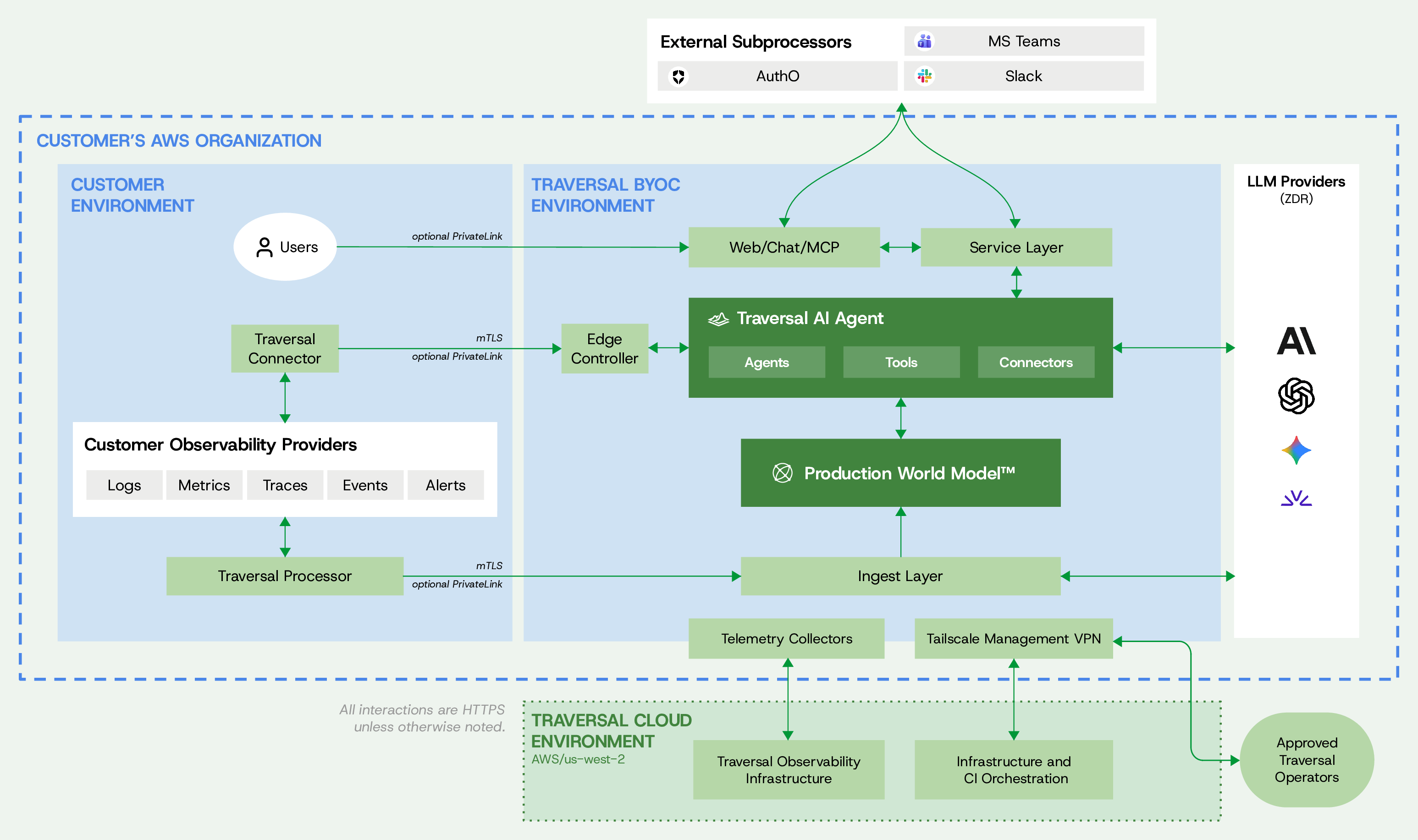
Traversal’s web application and authentication are currently handled by external providers outside of the BYOC deployment. A private deployment option for those services will be available in the future.
Networking
The entirety of the Traversal BYOC environment is deployed in a dedicated VPC, with all relevant infrastructure spread across multiple availability zones and hosted in private subnets. Traversal requires a dedicated/20 Class A CIDR block for its VPC, with at least three /22 private subnets — one per distinct availability zone — for its deployment and operations. Public subnets, when used, are sized as /24 and fit within the remaining /22 of address space.
Compute
All compute powering Traversal’s services, data stores, data pipelines, agentic workflows, and applications, runs on cloud instances (in AWS, EKS-on-EC2) and managed cloud services inside of the provided, dedicated cloud account.AI Models and Inference
Traversal uses frontier AI models (LLMs) to power its AI SRE agent. At your discretion, those models can be cloud-hosted (from LLM providers directly), routed through a private gateway, or fully hosted in your cloud environment (in AWS, with Bedrock).Access control
Access to your BYOC deployment of Traversal by your users is always secured and controlled by Single Sign-on (SSO) with your Identity Provider. Deployment and management of infrastructure, as well as operational access by Traversal, is performed through a cross-account IAM AssumeRole, scoped to the dedicated AWS account that hosts your Traversal BYOC deployment. Access by Traversal operators for maintenance and support is made through a secure and audited Tailscale-based VPN, restricted to authorized Traversal personnel only, and always secured by SSO with two-factor authentication.Telemetry
Two categories of telemetry data leave your BYOC deployment: system telemetry, used to monitor and support your deployment, and usage telemetry, used for product analytics, customer success, and billing. They’re handled differently.System telemetry
By default, system telemetry (metrics, logs, and traces about your Traversal deployment) is sent to Traversal’s centralized observability solution outside of your environment. If needed, some telemetry attributes can be redacted or filtered before leaving your BYOC deployment. If your requirements call for it, you can instead opt to keep system telemetry and monitoring entirely within your environment. In that configuration, alerts derived from that telemetry must still be allowed to egress to Traversal’s on-call solution (PagerDuty), so Traversal operators can be notified of and respond to issues affecting your deployment.Usage telemetry
Regardless of your system telemetry configuration, Traversal always collects the following usage telemetry, which leaves your environment:- Client-side user analytics — events generated by user interactions in the web app
- Server-side user analytics — user events and feedback signals, such as thumbs up/down reactions
- Usage data — investigations initiated, follow-ups initiated, and activity of Traversal workers
Usage telemetry never contains customer data.This list reflects what Traversal collects today and may change at any time as our needs evolve, particularly to support product analytics, customer success, and customer billing.
Data security
All data stored by Traversal in databases, network-attached storage volumes, and cloud storage buckets remains in your AWS account dedicated for Traversal’s BYOC deployment. Data is always encrypted at rest and in-transit by best-in-class encryption from your cloud provider (AES-256 and TLS1.3).Network security
Within the Traversal platform, all service-to-service traffic is authenticated and encrypted in-transit with mTLS/TLS1.3. Connections to your private data sources and environments are always made through dedicated, private, secure, and encrypted network paths with the Traversal Connector.Ingress
By default, no inbound connections to your Traversal BYOC deployment can be made from the public internet. Your access and connection to Traversal is routed through your private network. The following inbound connections (through secure PrivateLink service endpoints) must be established and allowed:- From your users to Traversal’s web application and API;
- From your Traversal Connector to the Edge Controller in your Traversal BYOC deployment;
- If deployed, from your Traversal Processor to your Traversal BYOC deployment’s data ingest endpoint.
https://slack.<customer>.traversal.com.
Egress
To ensure the proper operation of your Traversal BYOC deployment, the following outbound connections must be allowed:- To
login.traversal.comand*.auth0.comfor authentication; - To
telemetry.traversal.comfor reporting usage telemetry, and — unless you’ve opted to keep system telemetry within your environment — system telemetry, to Traversal; - To
*.rudderstack.comfor user telemetry; - To
*.pagerduty.comfor monitoring and alerting; - To
api.sendgrid.comfor transactional email delivery; - To
*.tailscale.comfor Traversal’s Tailscale-based operational VPN (required for upgrades, maintenance, and support); - To
*.okta.comfor authentication of Traversal operators with our identity provider; - To
*.letsencrypt.orgfor issuance of SSL/TLS certificates; - To
*.github.comand*.githubusercontent.comfor pulling Traversal platform repositories (required for deployment and upgrades); - To
*.ghcr.ioand*.docker.io(and*.cloudflare.docker.comfor Docker Hub image layers) for pulling third-party Docker images; - To
*.pypi.organdfiles.pythonhosted.orgfor pulling Python dependencies; - If configuring integrations with any third-party vendor, to their endpoint domains:
- To
*.slack.comfor the Traversal Slack app - To
api.anthropic.comand/orapi.openai.comfor access to our LLM providers if you’re not using Bedrock
- To
Your Traversal BYOC deployment runs on AWS services (such as EKS, EC2, S3, ECR, STS, and — if you use Bedrock for inference — Amazon Bedrock) and must be able to reach their service APIs. You can satisfy this in one of two ways:
- Allow egress to AWS service endpoints by permitting outbound HTTPS to
*.amazonaws.comand*.api.aws; or - Provision VPC endpoints for the required AWS services within your VPC, keeping traffic on the AWS network so it never traverses your egress path.
- Your Traversal BYOC deployment at
<customer>.traversal.comandapi.<customer>.traversal.com; login.traversal.comand*.auth0.comfor authentication;- Our user telemetry data processors:
*.rudderstack.com*.ingest.sentry.io
Deployment
To deploy Traversal BYOC, after establishing your agreement with Traversal and reviewing the responsibility matrix below, you must:1
Provision a new, dedicated AWS account attached to your organization, specifically for use by and for Traversal.
2
Deploy the Traversal BYOC AWS CloudFormation Template into this account to initialize a provisioning IAM role used by Traversal for deployment and operations.
3
Provide the AWS account ID and IAM role reference (ARN) from the outputs of the CloudFormation stack to Traversal.
https://<customer>.traversal.com. Following this initial deployment, and depending on the needs of your environment, you will:
1
Deploy the Traversal Connector to enable access to your private telemetry and data sources in your environment
2
Work with Traversal’s Forward Deployed Engineers to establish PrivateLink endpoints between your environment and your Traversal BYOC deployment